Convenience has always been central to the convenience store industry.
Now that expectation extends beyond consumers.
Retailers increasingly expect their suppliers and distributors to provide the same kind of fast, intuitive digital experiences they encounter elsewhere in business and everyday life.
They want to check product availability without making a phone call. They want to place an order after normal business hours. They want easy access to pricing, invoices, order history and account information.
For convenience store distributors, this shift is making B2B digital ordering an increasingly important part of customer service.
The opportunity isn’t simply moving orders online. It’s creating a more efficient connection between distributors and their retail customers.
What Is B2B Digital Ordering?
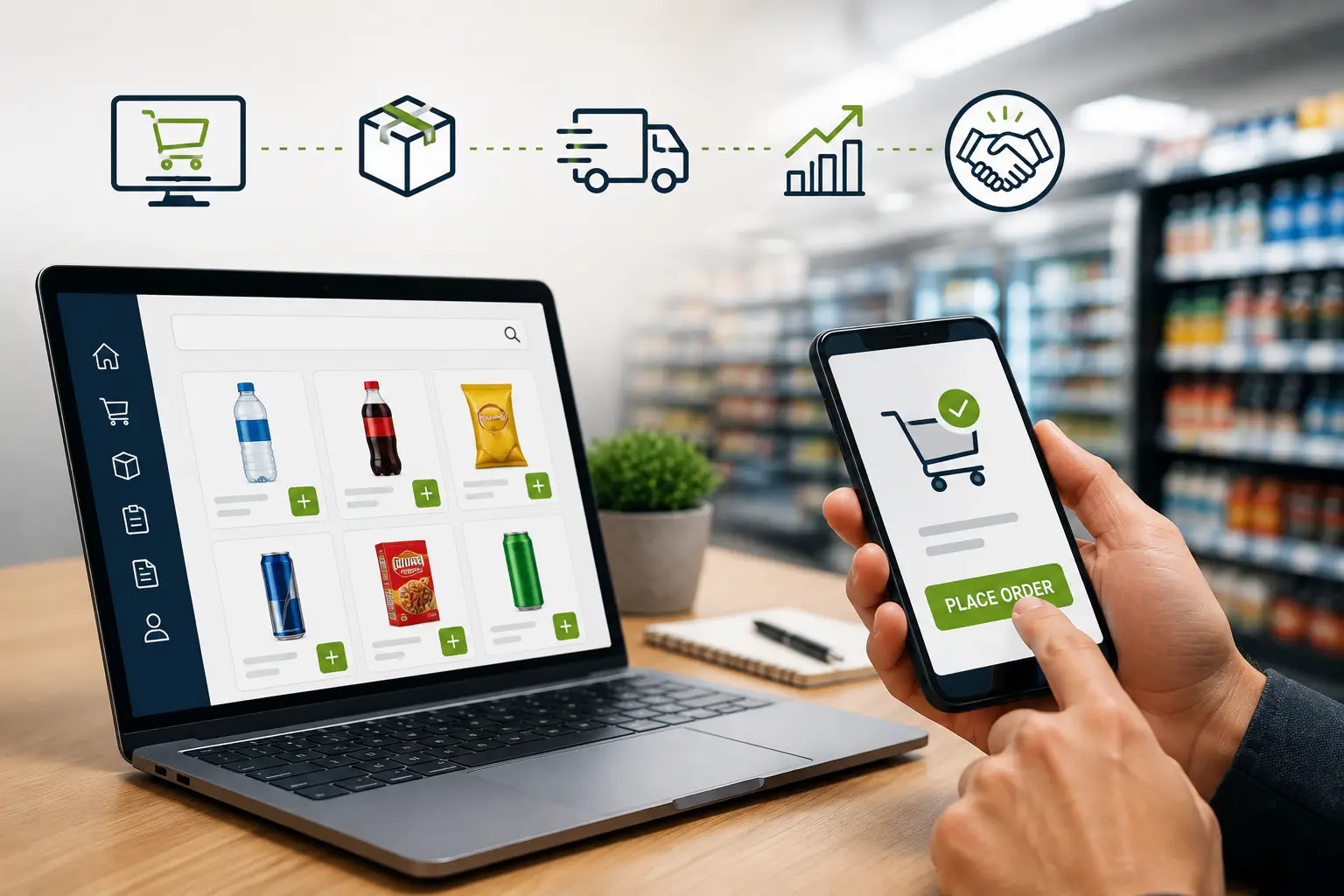
B2B digital ordering allows retail customers to interact with their distributor through an online ordering environment rather than relying exclusively on phone calls, emails, sales representatives or handwritten orders.
Depending on the system, customers may be able to:
- Browse available products
- Review pricing
- Place orders
- Reorder frequently purchased products
- Review previous orders
- Access invoices
- Check account information
- Manage returns or other requests
The result is a more convenient ordering experience for the retailer and a more streamlined workflow for the distributor.
Why Convenience Retailers Expect More Digital Access
Consumer technology has changed expectations everywhere.
Retail operators routinely use digital platforms for banking, purchasing, scheduling, communication and business management.
It is increasingly difficult to justify a supplier relationship that requires a retailer to call during business hours simply to retrieve routine information or place a straightforward order.
Digital access provides something particularly valuable in convenience retail:
flexibility.
Store managers operate early mornings, late evenings, weekends and holidays.
Their ordering requirements don’t always fit neatly into traditional office hours.
A digital ordering portal allows customers to interact with their distributor when it works for them.
7 Benefits of B2B Digital Ordering for Convenience Distributors
1. Make Ordering More Convenient
The most obvious benefit is customer convenience.
Retailers can place orders when they’re ready rather than waiting for a salesperson or customer service representative.
That may mean ordering:
- Early in the morning
- Late at night
- Between store responsibilities
- During weekends
- After reviewing current inventory
Removing unnecessary friction makes the distributor easier to do business with.
2. Reduce Manual Order Entry
Orders received by phone, email or handwritten notes frequently require an employee to enter information manually.
Every additional handoff creates another opportunity for:
- Incorrect quantities
- Wrong SKUs
- Transcription errors
- Duplicate orders
- Missed information
Digital ordering allows customer selections to flow more directly into the ordering process.
That can reduce administrative work while improving accuracy.
3. Give Sales Teams More Time to Sell
Sales representatives provide significantly more value when they’re helping customers grow rather than spending most of their time taking routine orders.
Digital self-service can shift repetitive transactions away from sales teams.
Representatives can spend more time discussing:
- New products
- Promotions
- Assortment opportunities
- Slow-moving inventory
- Category performance
- Customer growth opportunities
Digital ordering doesn’t have to replace the salesperson.
It can make the salesperson more valuable.
4. Improve Product Discovery
A phone order naturally favors products the customer already knows.
A digital catalog creates additional opportunities for retailers to discover:
- New products
- Promotional items
- Seasonal products
- Alternative pack sizes
- Related categories
That creates an opportunity to transform ordering from a purely transactional process into a merchandising and sales channel.
5. Provide Better Account Visibility
Retail customers frequently need information beyond product ordering.
Common questions include:
- What did I order last week?
- What was the price of this item?
- Where is my invoice?
- What products do I normally purchase?
- What is my account history?
When routine information is available through self-service, customers get answers faster and distributor employees spend less time retrieving documents and responding to repetitive requests.
6. Improve Order Accuracy
Digital ordering provides customers with an opportunity to review their selections before submitting an order.
Clear product information can help reduce confusion around:
- Similar SKUs
- Pack sizes
- Quantities
- Product descriptions
More accurate orders mean fewer corrections downstream.
That can contribute to better picking, invoicing and delivery performance.
7. Strengthen the Customer Experience
Distribution technology is often evaluated in terms of internal efficiency.
But technology also shapes how customers experience the distributor.
Consider two scenarios.
In the first, a retailer needs to call, leave a message and wait for someone to retrieve information.
In the second, the retailer logs into a portal and finds what they need immediately.
That difference matters.
In competitive markets, ease of doing business can become an important reason customers stay with a distributor.
Digital Ordering Is Not About Eliminating Relationships
One concern surrounding self-service technology is that it will make distributor relationships less personal.
The opposite can happen.
Consider how much customer interaction is currently consumed by administrative questions:
“Can you send me that invoice?”
“What did I order last time?”
“Can you add another case?”
“What is the price of this item?”
When technology handles routine transactions, employees gain more time for conversations that actually strengthen relationships.
Customer service teams can focus on resolving exceptions.
Salespeople can focus on helping customers grow.
Managers can focus on improving service.
The human relationship remains important. Technology simply removes unnecessary friction around it.
Why Mobile Accessibility Matters
Convenience store operators rarely spend their entire day behind a desk.
They may be:
- Walking the store
- Checking inventory
- Receiving deliveries
- Reviewing displays
- Managing employees
That makes mobile accessibility particularly valuable.
A browser-based ordering experience can allow customers to access information from a phone, tablet or computer without requiring them to return to a back office.
For convenience retail, the ability to conduct business from wherever the work is happening can significantly improve usability.
Connecting Digital Ordering With Distribution Operations
A customer portal becomes considerably more valuable when it is connected with the distributor’s core business data.
Ideally, the ordering experience should connect with information such as:
- Customer-specific pricing
- Product information
- Order history
- Inventory availability
- Billing information
- Account data
Disconnected e-commerce systems can create another information silo.
Integration helps ensure the customer-facing experience reflects the same information used by distributor operations.
How Digital Ordering Supports Better Data
Digital interactions also generate useful information.
Distributors can gain insight into:
- What customers search for
- What they reorder frequently
- Which products attract attention
- When customers typically order
- Which products are purchased together
- Where customers abandon potential purchases
Over time, this information can support better merchandising, promotions and customer conversations.
The digital ordering channel therefore becomes more than a transaction tool.
It becomes another source of customer intelligence.
B2B Digital Ordering and Customer Retention
Price will always matter in distribution.
So will fill rates, delivery performance and product availability.
But customer experience increasingly matters too.
When two distributors provide similar products and service levels, the company that is easier to work with can have a meaningful advantage.
Digital self-service can contribute to retention by providing:
- Greater convenience
- Faster access to information
- Fewer ordering errors
- More transparency
- Less administrative friction
Small improvements repeated across hundreds of interactions can significantly influence the overall customer relationship.
How CDR Software Supports Digital Customer Experiences
CDR Software provides integrated technology designed specifically around the operational requirements of convenience store distributors.
The DAC Portal provides a browser-based environment that can give retail customers digital access to important account and ordering functionality.
Connecting customer-facing tools with distribution operations can help distributors streamline routine transactions while maintaining visibility across the business.
Rather than creating another disconnected system, integrated digital tools can help connect the customer experience with the processes already supporting inventory, orders, billing and distribution.
What Distributors Should Look for in a B2B Ordering Portal
When evaluating digital ordering capabilities, consider whether the system provides:
Easy Access
Customers shouldn’t need extensive training simply to place an order.
Mobile-Friendly Design
The experience should work effectively across phones, tablets and computers.
Customer-Specific Information
Pricing and account information should reflect the individual customer relationship.
Order History
Retailers should be able to quickly reference previous purchases.
Integrated Business Data
Information should connect with core distribution operations rather than creating another silo.
Secure Access
Customer and business information must remain appropriately protected.
Scalability
The system should support increasing order volume and customer adoption as digital usage grows.
The Future of Distributor-Retailer Relationships Is Hybrid
The future isn’t exclusively digital.
It isn’t exclusively personal either.
The strongest distributor-retailer relationships will likely combine both.
Routine transactions can happen digitally.
Complex questions can be handled by knowledgeable employees.
Sales representatives can use customer information to provide more relevant recommendations.
Customer service teams can focus on exceptions that genuinely require assistance.
That hybrid model gives retailers convenience without sacrificing the relationships that remain central to wholesale distribution.
Conclusion
B2B digital ordering is becoming an important part of the convenience distribution customer experience.
Retailers increasingly expect the ability to access information, place orders and manage routine account activity on their own schedule.
For distributors, meeting that expectation can deliver benefits far beyond convenience.
Digital ordering can reduce manual work, improve order accuracy, free sales teams for higher-value conversations and make the distributor easier to do business with.
The goal isn’t replacing relationships with technology.
It’s using technology to remove friction so those relationships can become stronger.
Frequently Asked Questions
What is B2B digital ordering?
B2B digital ordering allows business customers to browse products, place orders and access account information through an online portal or similar digital platform.
Why is digital ordering important for convenience store distributors?
Convenience retailers operate outside traditional business hours and increasingly expect flexible access to suppliers. Digital ordering lets customers interact with distributors when it is most convenient for them.
Does digital ordering replace sales representatives?
No. Digital self-service can handle routine transactions while allowing sales representatives to spend more time on strategic conversations, promotions, product recommendations and customer growth.
Can B2B ordering improve order accuracy?
Digital ordering can reduce manual transcription and allow customers to verify SKUs, quantities and product information before submitting orders.
What should convenience distributors look for in a customer portal?
Important capabilities include mobile access, customer-specific pricing, product information, order history, billing access, security and integration with core distribution operations.
What is the DAC Portal?
CDR Software’s DAC Portal is a browser-based customer ordering and account-management environment designed to extend digital self-service capabilities to retail customers.