
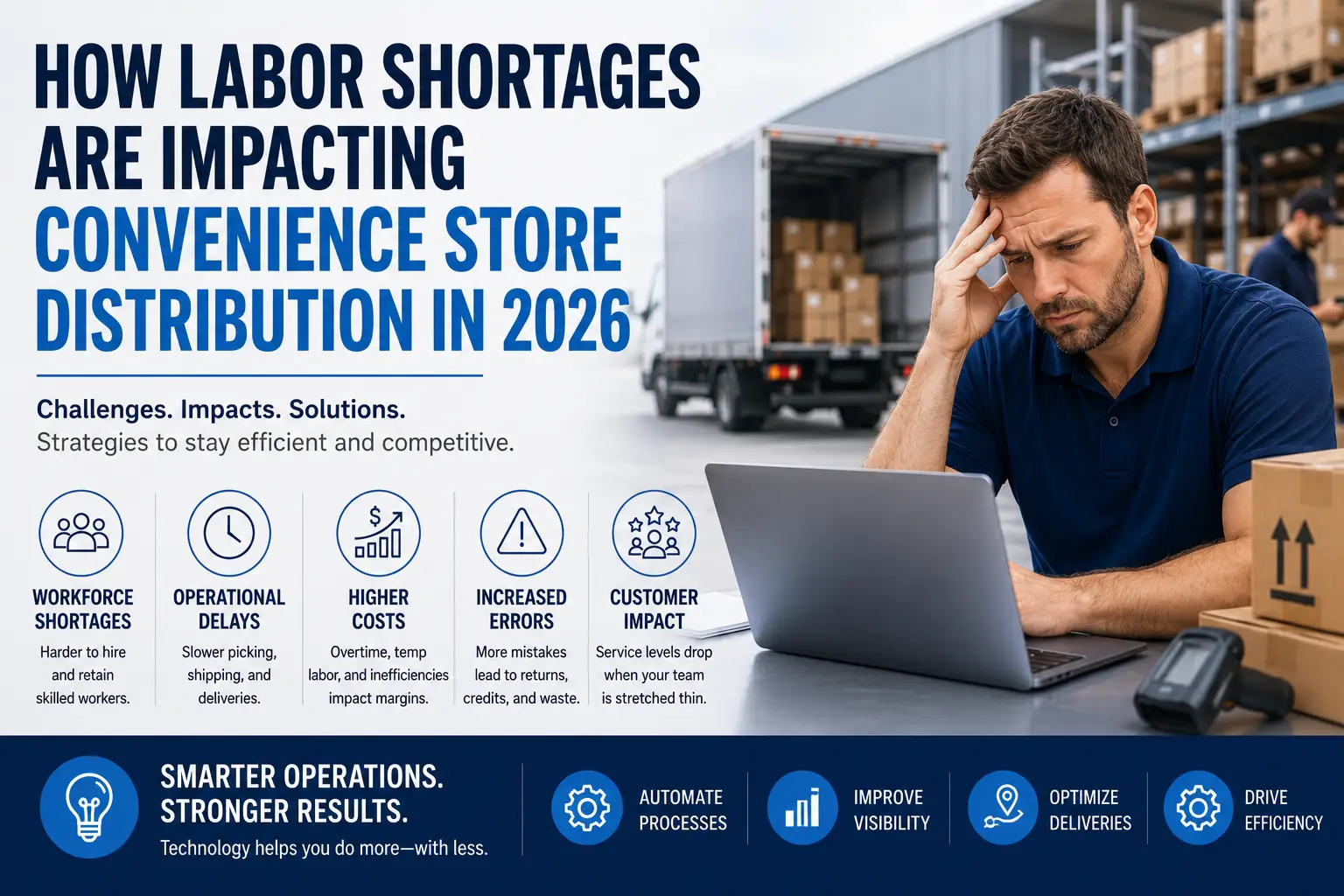
Labor shortages continue to be one of the biggest challenges facing convenience store distribution in 2026. From warehouse staffing to delivery drivers, distributors are struggling to maintain efficiency while managing rising costs and increasing demand.
For convenience distributors, labor constraints don’t just slow operations—they impact order accuracy, delivery performance, and profitability.
In this article, we’ll explore how labor shortages are affecting the industry and what distributors can do to maintain efficiency and stay competitive.
Why Labor Shortages Are a Growing Issue
The convenience distribution industry is facing a perfect storm of workforce challenges:
- High turnover in warehouse and delivery roles
- Difficulty recruiting qualified drivers
- Increasing wage pressures
- Growing operational complexity
As demand for convenience products continues to rise, these labor challenges are becoming more difficult to manage.
Where Labor Shortages Impact Operations Most
1. Warehouse Operations
Staffing shortages in warehouses can lead to:
- Slower order picking
- Increased picking errors
- Delayed shipments
Without enough workers, maintaining efficiency becomes difficult.
2. Delivery and Route Management
Driver shortages are one of the most critical issues.
This results in:
- Missed or delayed deliveries
- Reduced route capacity
- Increased pressure on existing drivers
3. Inventory Management
Limited staffing affects inventory accuracy.
This can lead to:
- Stock discrepancies
- Poor cycle counting practices
- Increased shrink
4. Administrative Workload
Fewer staff means more manual work for remaining employees.
This includes:
- Data entry
- Order processing
- Reconciliation tasks
These inefficiencies slow down operations.
How Labor Shortages Affect Profitability
Labor shortages directly impact the bottom line.
Common financial effects include:
- Higher labor costs due to overtime
- Increased operational inefficiencies
- More errors leading to returns and credits
- Reduced customer satisfaction
Without solutions, these issues can quickly erode margins.
7 Strategies to Overcome Labor Shortages
1. Automate Manual Processes
Reducing manual work helps teams operate more efficiently with fewer employees.
Automation can be applied to:
- Order processing
- Inventory tracking
- Billing and invoicing
2. Improve Workflow Efficiency
Streamlining processes reduces wasted time and effort.
Focus on:
- Simplifying workflows
- Eliminating redundant steps
- Standardizing procedures
3. Use Real-Time Data for Decision-Making
Access to real-time data helps managers make faster, better decisions.
This reduces delays and improves operational responsiveness.
4. Optimize Route Planning
Efficient routes reduce the need for additional drivers.
This helps:
- Maximize existing capacity
- Reduce fuel costs
- Improve delivery times
5. Enhance Employee Productivity
Providing better tools helps employees work more efficiently.
This includes:
- Mobile tools for drivers
- Digital systems for warehouse operations
- Integrated platforms for managers
6. Reduce Errors and Rework
Errors create additional work.
Improving accuracy helps reduce:
- Returns
- Corrections
- Customer complaints
7. Invest in Scalable Technology
Technology enables growth without increasing headcount.
Systems that scale allow distributors to:
- Handle higher volumes
- Improve efficiency
- Reduce reliance on manual labor
The Role of Distribution Software in Addressing Labor Challenges
Modern distribution software plays a key role in overcoming labor shortages.
It helps by:
- Automating repetitive tasks
- Providing real-time visibility
- Connecting operations across departments
- Reducing manual data entry
CDR Software offers solutions designed specifically for convenience distributors, helping businesses improve efficiency and operate effectively with leaner teams.
How Technology Helps Future-Proof Operations
Labor shortages are not a temporary issue—they are an ongoing industry challenge.
Distributors that invest in technology today can:
- Reduce dependency on manual labor
- Improve operational resilience
- Adapt to changing workforce conditions
- Scale more efficiently
Technology is becoming a critical factor in long-term success.
Conclusion
In 2026, labor shortages are reshaping how convenience store distributors operate. Companies that rely on manual processes will struggle to keep up with demand, while those that embrace automation and efficiency will gain a competitive advantage.
By improving workflows, leveraging real-time data, and investing in integrated systems, distributors can overcome labor challenges and maintain strong performance.
The future of convenience distribution belongs to companies that can do more—with less.
Frequently Asked Questions
Why are labor shortages affecting convenience distribution?
High turnover, driver shortages, and increasing demand are creating workforce challenges across the industry.
How can distributors manage with fewer workers?
By automating processes, improving efficiency, and using integrated technology systems.
What areas are most impacted by labor shortages?
Warehouse operations, delivery routes, inventory management, and administrative tasks.
How does software help reduce labor dependency?
It automates tasks, improves visibility, and reduces manual work, allowing teams to operate more efficiently.