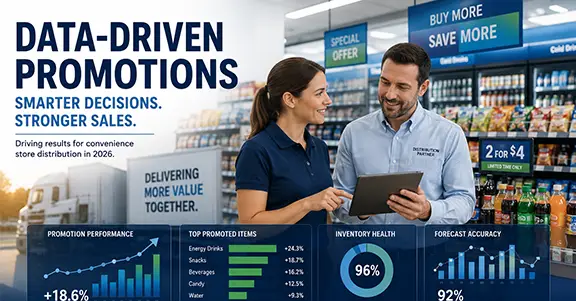
Promotions have always been a powerful sales driver in convenience retail. But in today’s competitive market, simply offering discounts isn’t enough. Retailers and distributors alike are looking for smarter ways to maximize promotional performance while protecting margins.
For convenience store distributors, the opportunity lies in using data to determine what products to promote, when to promote them, and how to ensure inventory is available when demand spikes.
In 2026, data-driven promotions are becoming a competitive advantage, helping distributors improve forecasting, strengthen retailer partnerships, and increase sales throughout the supply chain.
In this guide, we’ll explore how distributors can use operational data and analytics to build more successful promotional strategies.
Why Promotions Matter More Than Ever
Convenience retailers rely on promotions to:
- Increase store traffic
- Boost basket size
- Introduce new products
- Support seasonal campaigns
- Improve customer loyalty
For distributors, these promotions create opportunities to:
- Increase order volume
- Improve inventory turnover
- Strengthen customer relationships
- Drive higher revenue
However, successful promotions require accurate planning and operational coordination.
The Challenges of Promotional Planning
Promotional demand can be unpredictable.
Without accurate data, distributors often experience:
Inventory Shortages
High-performing products sell out before promotions end.
Overstocking
Overestimating promotional demand ties up working capital.
Delivery Bottlenecks
Unexpected order spikes strain warehouse and transportation operations.
Missed Sales Opportunities
Poor forecasting can prevent retailers from fully capitalizing on promotions.
What Makes a Promotion Data-Driven?
A data-driven promotion uses operational insights instead of assumptions.
Successful distributors analyze:
- Historical sales performance
- Seasonal demand patterns
- Customer purchasing behavior
- Inventory turnover
- Regional buying trends
- Promotional ROI
These insights help determine which products are most likely to generate profitable results.
7 Ways Data Improves Promotional Performance
1. Identify Top-Selling Products
Historical sales data reveals which products consistently perform well during promotions.
Prioritize products that deliver:
- High demand
- Strong margins
- Reliable inventory availability
2. Forecast Promotional Demand More Accurately
Combining historical sales with current market conditions improves demand forecasting.
Better forecasts help reduce:
- Stockouts
- Excess inventory
- Emergency replenishment
3. Align Inventory with Marketing Campaigns
Inventory planning should begin before promotions launch.
This ensures retailers have sufficient inventory throughout the campaign.
4. Optimize Delivery Schedules
Promotional periods often increase order volume.
Optimized delivery planning helps maintain:
- On-time deliveries
- Product availability
- Customer satisfaction
5. Track Promotion Performance
Measure results using metrics such as:
- Sales growth
- Inventory turnover
- Fill rate
- Promotion profitability
These insights improve future promotional planning.
6. Improve Retailer Collaboration
Sharing data with retail customers helps align promotional expectations.
Working together allows both parties to:
- Plan inventory
- Improve replenishment
- Reduce missed sales opportunities
7. Learn from Every Promotion
Every campaign generates valuable data.
Reviewing performance helps answer important questions:
- Which products exceeded expectations?
- Which promotions underperformed?
- How accurate were forecasts?
- Were delivery schedules sufficient?
Continuous improvement creates stronger future campaigns.
Key Metrics Every Distributor Should Track
Promotion Lift
Measures the increase in sales generated during a promotion.
Fill Rate
Shows how effectively promotional demand was fulfilled.
Inventory Turnover
Evaluates how efficiently promotional inventory moved.
Forecast Accuracy
Compares projected promotional demand against actual sales.
Gross Margin
Measures profitability before, during, and after promotional campaigns.
How Distribution Software Supports Better Promotions
Modern distribution software gives convenience distributors access to real-time operational insights that improve promotional planning.
Integrated systems help distributors:
- Monitor inventory levels
- Analyze sales trends
- Improve demand forecasting
- Coordinate deliveries
- Track promotion performance
CDR Software provides convenience distributors with integrated distribution management tools that improve visibility across inventory, orders, delivery, and reporting, helping businesses execute more profitable promotional campaigns.
Looking Ahead
As competition continues to increase across convenience retail, successful promotions will rely less on intuition and more on data.
Distributors that use analytics to guide promotional planning will improve service levels, reduce waste, and strengthen retailer relationships.
Data-driven decision-making isn’t simply a technology initiative—it’s becoming a core competitive advantage.
Conclusion
Promotions remain one of the most effective ways to increase sales in convenience retail, but only when supported by accurate forecasting, inventory visibility, and operational execution.
By leveraging real-time data and integrated distribution software, convenience distributors can improve promotional performance while delivering greater value to retail customers.
Companies that embrace data-driven promotions today will be better positioned to increase profitability and drive sustainable growth tomorrow.
Frequently Asked Questions
Why are data-driven promotions important?
They help distributors make better inventory, forecasting, and delivery decisions while improving promotional performance.
What data should distributors analyze?
Historical sales, inventory turnover, customer buying patterns, seasonal trends, and promotional ROI.
How can distributors reduce stockouts during promotions?
By improving demand forecasting, monitoring inventory in real time, and coordinating closely with retail customers.
How does distribution software improve promotions?
Integrated software provides visibility into inventory, orders, deliveries, and reporting, allowing distributors to plan and execute promotions more effectively.