
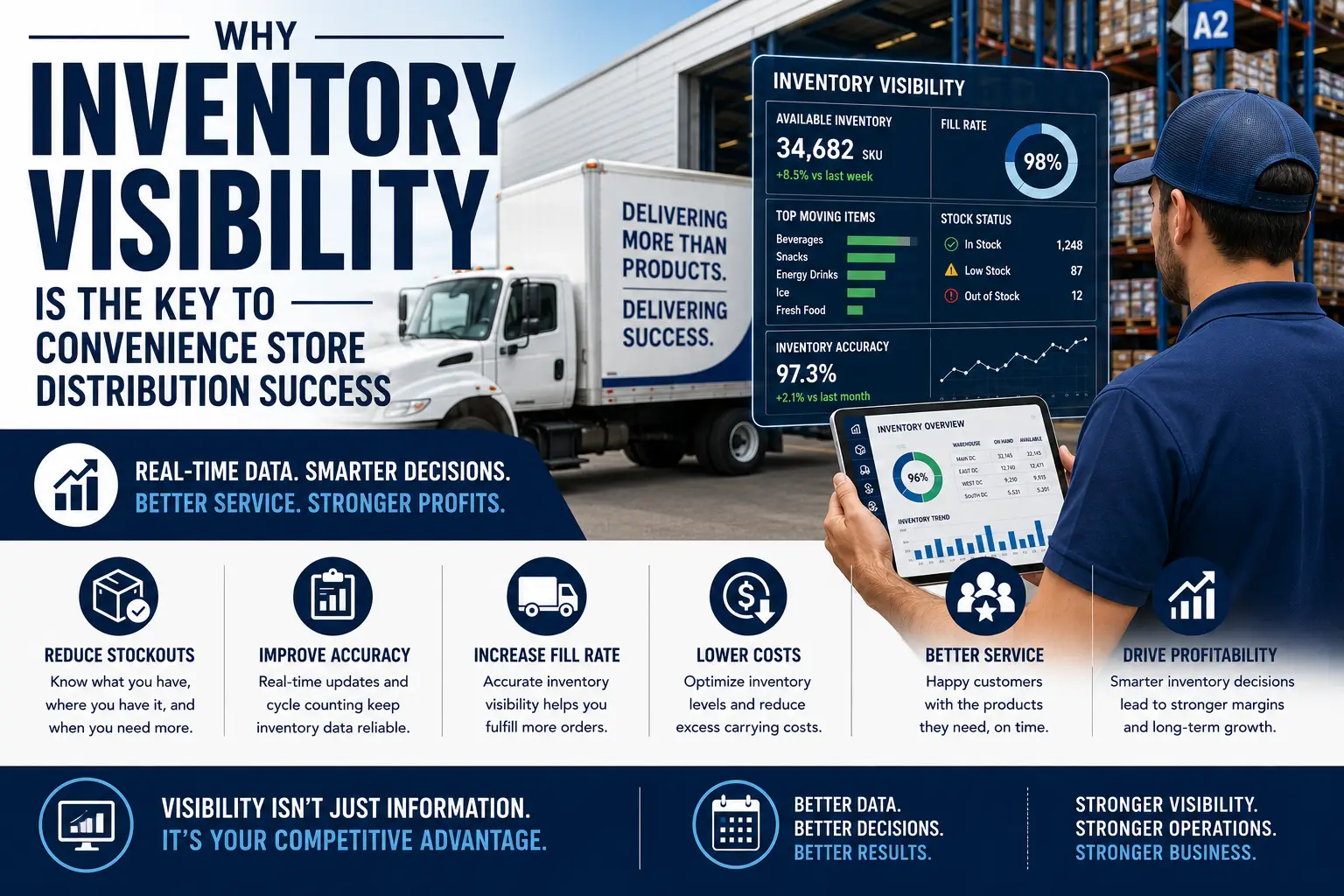
Inventory is the lifeblood of convenience store distribution. Every order, delivery, and customer relationship depends on having the right products available at the right time.
Yet many distributors still struggle with inventory blind spots caused by manual processes, disconnected systems, or delayed reporting. The result is stockouts, excess inventory, delivery disruptions, and reduced profitability.
In 2026, inventory visibility has become one of the most important competitive advantages for convenience distributors. Companies with real-time insight into inventory movement can make faster decisions, improve customer service, and operate more efficiently.
In this guide, we’ll explore why inventory visibility matters and how distributors can strengthen it across their operations.
What Is Inventory Visibility?
Inventory visibility is the ability to accurately monitor inventory levels, movement, and availability across your distribution operation in real time.
Effective inventory visibility allows distributors to answer critical questions, including:
- What inventory is currently available?
- Which products are moving fastest?
- Where are potential shortages developing?
- Which locations require replenishment?
- What inventory is at risk of becoming obsolete?
Having immediate access to this information supports better operational decisions throughout the supply chain.
Why Inventory Visibility Matters More Than Ever
Today’s convenience distributors face increasing operational complexity.
Contributing factors include:
- Expanding product assortments
- Seasonal demand fluctuations
- More frequent deliveries
- Labor shortages
- Higher customer service expectations
Without accurate inventory visibility, responding to these challenges becomes significantly more difficult.
Common Problems Caused by Poor Inventory Visibility
Stockouts
Limited inventory insight often leads to unavailable products and missed sales opportunities.
Excess Inventory
Without accurate demand visibility, distributors may over-order products that move slowly.
Delivery Delays
Inventory discrepancies frequently result in incomplete orders and delayed deliveries.
Higher Operating Costs
Manual inventory checks and emergency replenishment increase labor and transportation expenses.
7 Ways to Improve Inventory Visibility
1. Centralize Inventory Data
Maintain one reliable source of inventory information across purchasing, order management, delivery, and accounting.
A centralized approach reduces duplicate data and improves reporting consistency.
2. Track Inventory Movement in Real Time
Real-time updates allow teams to monitor:
- Receipts
- Transfers
- Shipments
- Returns
- Adjustments
Immediate visibility helps identify issues before they impact customers.
3. Improve Cycle Counting
Regular cycle counts verify inventory accuracy throughout the year.
Benefits include:
- Earlier discrepancy detection
- Improved inventory confidence
- Better replenishment decisions
4. Monitor Fast-Moving Products
Some products require closer attention due to higher sales velocity.
Examples include:
- Beverages
- Snacks
- Fresh food
- Seasonal merchandise
Monitoring these categories closely helps maintain product availability.
5. Improve Inventory Reporting
Operational dashboards should provide quick access to key metrics, including:
- Inventory accuracy
- Fill rate
- Inventory turnover
- Days of inventory on hand
These metrics help managers make informed decisions.
6. Strengthen Warehouse Processes
Consistent receiving, picking, and shipping procedures improve inventory accuracy and reduce unnecessary adjustments.
Standardized workflows also support employee productivity.
7. Connect Inventory with Distribution Operations
Inventory data becomes more valuable when connected with:
- Customer orders
- Delivery schedules
- Purchasing
- Accounting
Integrated systems improve operational coordination and reduce manual work.
Key Inventory Metrics Every Distributor Should Track
Inventory Accuracy
Measures how closely physical inventory matches recorded inventory.
Inventory Turnover
Evaluates how efficiently products move through the business.
Fill Rate
Measures how consistently customer demand is fulfilled.
Stockout Frequency
Tracks how often products become unavailable.
Days of Inventory on Hand
Helps determine whether inventory levels are aligned with demand.
How Technology Improves Inventory Visibility
Modern distribution software helps convenience distributors:
- View inventory in real time
- Improve inventory accuracy
- Reduce manual processes
- Support faster decision-making
- Improve reporting across departments
CDR Software provides integrated distribution management solutions that help convenience distributors strengthen inventory visibility while improving operational efficiency across inventory, orders, delivery, and accounting.
The Business Value of Better Inventory Visibility
Improving inventory visibility delivers measurable operational benefits, including:
- Reduced stockouts
- Improved customer satisfaction
- Lower carrying costs
- Better forecasting
- Faster response to demand changes
- Improved profitability
As convenience distribution continues to evolve, visibility becomes a strategic advantage rather than simply an operational metric.
Conclusion
Inventory visibility is no longer just about knowing what’s in the warehouse. It’s about giving every department access to accurate, timely information that supports better decisions.
Distributors that improve visibility can reduce operational costs, improve service levels, and respond more effectively to changing customer demand.
As competition increases throughout 2026, companies that invest in stronger inventory visibility will be better positioned for long-term success.
Frequently Asked Questions
What is inventory visibility?
Inventory visibility is the ability to monitor inventory levels, movement, and availability in real time across a distribution operation.
Why is inventory visibility important?
It helps reduce stockouts, improve customer service, support better forecasting, and lower operating costs.
How can distributors improve inventory visibility?
By centralizing inventory data, improving cycle counting, strengthening warehouse processes, and connecting inventory with other business operations.
How does distribution software improve inventory visibility?
Integrated distribution software provides real-time inventory information, reporting, and operational visibility that supports faster, more informed decision-making.