
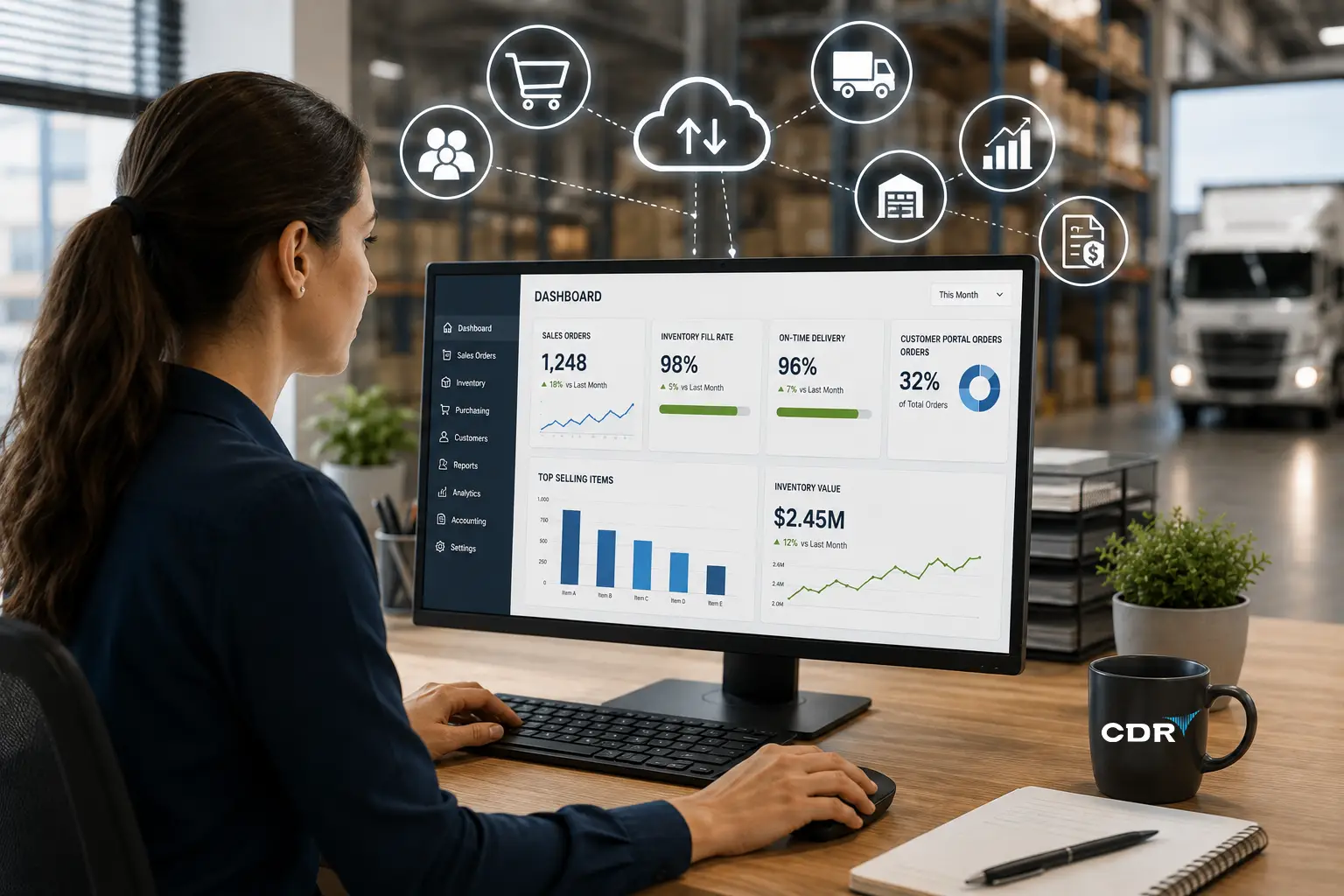
Convenience store distributors have more technology available to them than ever before.
Sales teams have customer information. Operations teams manage inventory and orders. Drivers rely on delivery information. Accounting tracks financial performance. Retail customers increasingly interact through digital ordering tools.
The problem begins when those systems don’t communicate effectively.
A customer updates an order, but the change doesn’t immediately reach operations. Inventory information differs between systems. Employees enter the same information multiple times. Managers export data into spreadsheets simply to understand what’s happening across the business.
These aren’t isolated technology problems.
They are symptoms of disconnected distribution systems, and they can create hidden costs throughout a convenience distribution operation.
In 2026, the competitive advantage isn’t necessarily having more technology. It’s making the technology and data you already rely on work together.
What Are Disconnected Distribution Systems?
Disconnected systems occur when different departments, applications, or business processes operate using separate information that isn’t automatically shared.
A distributor might have different tools for:
- Customer orders
- Inventory
- Purchasing
- Sales
- Delivery
- Accounting
- Reporting
- Customer portals
- Vendor information
Each system may perform its individual job effectively.
The problem is what happens between them.
When employees have to manually move information from one system to another, organizations create additional work, delays, and opportunities for error.
The Spreadsheet Problem
Spreadsheets remain useful business tools.
Problems arise when spreadsheets become the bridge connecting core distribution processes.
Consider a common workflow.
A manager exports inventory data from one system, sales information from another, and delivery information from somewhere else. Those files are combined into a spreadsheet so management can understand operational performance.
By the time the report is finished, some of the information may already be outdated.
The organization technically has the data.
What it doesn’t have is immediate visibility.
That distinction matters in a fast-moving distribution environment.
7 Hidden Costs of Disconnected Distribution Technology
1. Duplicate Data Entry
One of the clearest signs of disconnected technology is employees entering the same information multiple times.
For example, an order may arrive through one system and then need to be manually entered into another.
Duplicate entry consumes time and creates opportunities for:
- Incorrect quantities
- Wrong product numbers
- Customer information errors
- Pricing discrepancies
- Duplicate transactions
Every manual handoff introduces risk.
Integrated workflows allow information to move more efficiently between business processes.
2. Slower Decision-Making
Managers can’t make real-time decisions using yesterday’s information.
When operational data is distributed across multiple applications, employees may spend hours collecting and reconciling information before analysis even begins.
That delay can affect decisions around:
- Purchasing
- Inventory allocation
- Customer orders
- Delivery planning
- Promotions
- Staffing
Connected data reduces the time between identifying a problem and responding to it.
3. Inventory Blind Spots
Inventory touches nearly every area of convenience distribution.
Sales needs to know what’s available.
Purchasing needs to know what needs replenishment.
Customer service needs to understand whether an order can be fulfilled.
Operations needs accurate quantities for picking and delivery.
If these teams aren’t working from consistent inventory information, problems can quickly develop.
The result may include:
- Stockouts
- Excess inventory
- Incorrect customer commitments
- Emergency purchasing
- Order substitutions
A single source of inventory information helps teams make decisions using the same operational picture.
4. More Customer Service Friction
Disconnected systems don’t only affect employees.
Customers feel the consequences too.
Imagine a retailer calling about an order.
The customer service representative needs to check one system for the order, another for inventory, another for delivery information, and potentially another for billing.
Every additional lookup adds time.
Integrated information allows customer-facing employees to respond more quickly and confidently.
That can improve both employee productivity and the retailer experience.
5. Reporting That Requires Too Much Work
Management shouldn’t need a spreadsheet project every time it wants to answer a business question.
Yet many organizations still rely on manual reporting processes because operational information exists in different places.
Common questions become unnecessarily difficult:
- Which products are moving fastest?
- Which customers are increasing purchases?
- Where are fill rates declining?
- Which routes are becoming more expensive?
- How is inventory turnover changing?
- Which promotions produced results?
Connected distribution data creates a stronger foundation for business intelligence.
Instead of spending time assembling reports, teams can spend more time interpreting them.
6. Integration Problems Limit Automation
Automation depends on connected information.
A business can’t effectively automate a workflow if each step operates independently.
Consider replenishment.
To make a good replenishment decision, a distributor may need information about:
- Current inventory
- Open orders
- Historical demand
- Incoming purchases
- Customer requirements
- Lead times
When that information is fragmented, automation becomes significantly more difficult.
Integration creates the foundation needed for more advanced capabilities.
7. Disconnected Data Limits AI
Artificial intelligence is becoming one of the most discussed technologies in distribution.
But AI is only as useful as the data supporting it.
Organizations interested in AI-driven forecasting, analytics, replenishment, or operational recommendations first need accurate and accessible business information.
If customer, inventory, sales, and delivery information exists in disconnected silos, AI tools have an incomplete view of the operation.
The first step toward AI readiness isn’t necessarily buying an AI application.
It’s building a stronger data foundation.
Integration vs. Adding More Software
When organizations encounter an operational problem, the natural reaction is often to purchase another tool.
Sometimes that’s the correct answer.
But adding software without considering integration can create an even more complicated technology environment.
Before adding another application, distributors should ask:
Does this solve a problem or create another data silo?
Evaluate how a new system will connect with:
- Existing business software
- Customer information
- Inventory data
- Financial systems
- Vendor platforms
- Reporting tools
The goal should be a connected technology ecosystem rather than a collection of independent applications.
What Does an Integrated Distribution Operation Look Like?
An integrated environment allows information to move naturally between business processes.
For example:
Customer places an order → inventory updates → fulfillment receives the order → delivery is scheduled → invoice is generated → reporting reflects the transaction.
Employees don’t have to recreate the transaction at every stage.
The information follows the business process.
That can create improvements in:
Speed
Information reaches the people who need it sooner.
Accuracy
Fewer manual handoffs mean fewer opportunities for errors.
Visibility
Managers gain a clearer view of operations.
Customer Service
Employees can access more complete customer information.
Scalability
The business can process greater transaction volumes without adding equivalent amounts of administrative work.
6 Signs Your Distribution Technology Is Too Fragmented
How can you tell whether disconnected technology is affecting your operation?
Watch for these warning signs.
Employees Re-Enter Information
If teams regularly copy information between systems, integration opportunities probably exist.
Different Departments Have Different Numbers
Sales says inventory is available while operations says it isn’t.
That is a data problem.
Reporting Depends Heavily on Spreadsheets
If managers regularly export information simply to understand business performance, data may be too fragmented.
Customers Wait While Employees Search for Answers
Customer service shouldn’t require navigating numerous systems for routine questions.
New Technology Creates More Manual Work
Technology should eliminate steps, not introduce additional ones.
Nobody Trusts the Data
Perhaps the most serious warning sign is employees maintaining their own private spreadsheets because they don’t trust company-wide information.
Once that happens, the organization can end up with multiple versions of the truth.
Start Integration With Business Processes, Not Technology
Integration shouldn’t begin with a list of applications.
Begin with the business process.
Choose a workflow, such as customer order-to-delivery, and map every step.
Ask:
- Where does information enter the business?
- Who uses it?
- Where is it manually re-entered?
- Which systems need the same information?
- Where do delays occur?
- Which errors happen repeatedly?
This exercise often reveals integration opportunities quickly.
The objective isn’t connecting everything simply because it can be connected.
It’s removing friction from processes that matter.
Why APIs Matter in Modern Distribution
Application programming interfaces, or APIs, allow different software applications to exchange information.
For distributors, APIs can help connect business systems with external platforms such as:
- Vendor systems
- Retailer platforms
- Payment solutions
- Ecommerce tools
- Business intelligence applications
- Third-party services
API connectivity can reduce manual file transfers and create more timely information flows between organizations.
As distributor technology ecosystems become more sophisticated, integration capabilities will become increasingly important when evaluating software.
The Role of ERP in a Connected Distribution Strategy
For many distributors, ERP serves as the operational system of record.
Rather than having each application maintain its own independent version of customer, inventory, order, and financial information, an integrated ERP environment can provide a central foundation.
That doesn’t mean every business function must exist inside one application.
Specialized tools may still provide significant value.
The important question is whether those tools can communicate effectively with the core business system.
A connected architecture provides the benefits of specialized technology without sacrificing operational visibility.
How CDR Software Supports Connected Convenience Distribution
CDR Software develops integrated business technology specifically for convenience store distributors.
The DAC platform brings core distribution processes together across areas including:
- Customer orders
- Inventory
- Purchasing
- Delivery
- Financial management
- Reporting
- Customer-facing digital tools
CDR also supports integration with external business systems and industry platforms, helping distributors reduce information silos and create more connected workflows.
The objective is straightforward:
Give employees better access to the information they need without requiring them to spend their day moving data between disconnected applications.
Integration Creates the Foundation for What’s Next
Technology will continue changing rapidly.
Artificial intelligence, predictive analytics, automation, digital ordering, and advanced reporting will create new opportunities for convenience distributors.
But these technologies share one requirement:
good data.
Distributors with connected operational information will be better positioned to take advantage of emerging technologies.
Those relying heavily on disconnected applications and manual data movement may find modernization considerably more difficult.
Integration isn’t simply an IT project.
It’s a foundation for future growth.
Conclusion
The distribution technology conversation has changed.
The question is no longer simply:
What software do we need?
A better question is:
How well does our technology work together?
Disconnected systems create hidden costs through duplicate work, reporting delays, inconsistent data, customer service friction, and limited automation.
By creating a more connected technology environment, convenience store distributors can improve operational visibility, make faster decisions, reduce manual work, and build a stronger foundation for future technologies.
In 2026 and beyond, the distributors with the most software won’t necessarily have the advantage.
The distributors with the most connected operations will.
Frequently Asked Questions
What are disconnected systems in distribution?
Disconnected systems are applications or business processes that maintain separate information and require manual work to exchange data.
Why is software integration important for distributors?
Integration reduces duplicate data entry, improves visibility, increases data accuracy, accelerates reporting, and helps different departments work from consistent information.
How do disconnected systems affect inventory?
Separate inventory information can lead to inaccurate availability, stockouts, excess inventory, purchasing problems, and incorrect customer commitments.
Why is integration important for AI?
AI systems require accessible, accurate data. Fragmented information can limit the quality of forecasting, analytics, and automated recommendations.
What is the role of APIs in distribution software?
APIs allow different applications to exchange information automatically, helping distributors connect internal systems with vendors, customers, payment platforms, analytics tools, and other services.
Does integration mean every system needs to be replaced?
No. Integration can allow specialized applications to remain in place while exchanging information with the distributor’s primary business systems.