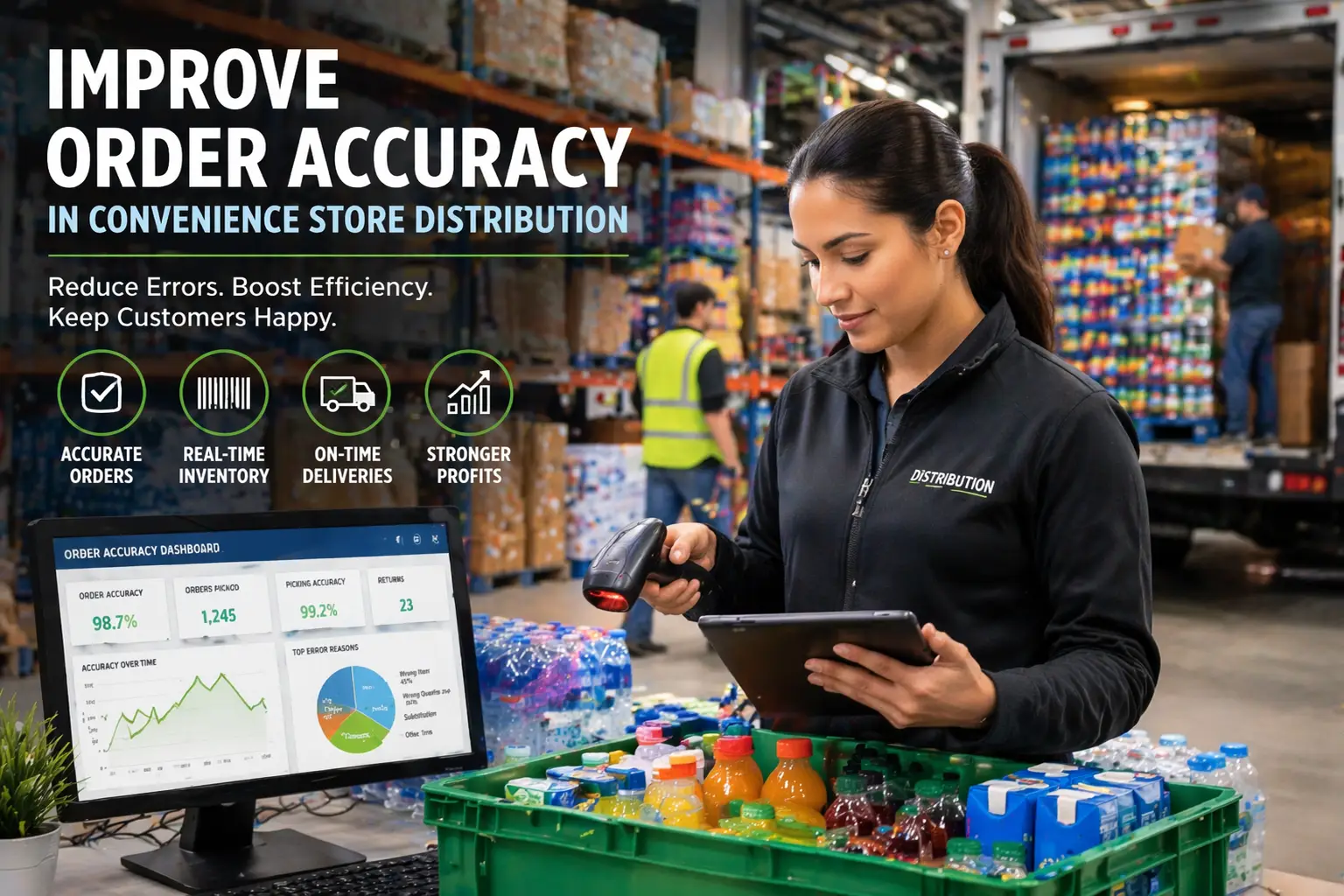
Order accuracy is one of the most critical performance metrics in convenience store distribution. In a fast-paced environment with thousands of SKUs, frequent deliveries, and tight margins, even small errors can lead to costly returns, customer dissatisfaction, and lost revenue.
In 2026, improving order accuracy in convenience store distribution is not just about reducing mistakes—it’s about increasing efficiency, protecting margins, and strengthening retailer relationships.
This guide explores the most common causes of order inaccuracies and how distributors can improve performance using better processes and integrated distribution systems.
What Is Order Accuracy in Convenience Distribution?
Order accuracy refers to how closely delivered products match what was ordered by the customer.
This includes:
- Correct products
- Correct quantities
- Accurate pricing and invoicing
- Proper handling of substitutions or returns
High order accuracy ensures smooth operations and minimizes costly corrections.
Why Order Accuracy Matters More Than Ever
As convenience distribution becomes more complex, the cost of errors continues to rise.
Key Impacts of Poor Order Accuracy
- Increased product returns and credits
- Delivery delays and additional trips
- Customer dissatisfaction and lost business
- Administrative time spent on corrections
- Inventory discrepancies
Improving accuracy directly improves profitability and customer retention.
Common Causes of Order Inaccuracies
Understanding the root causes is the first step to improvement.
1. Manual Data Entry Errors
Manual order entry and paper-based processes increase the risk of mistakes.
2. Picking Errors in the Warehouse
Incorrect item selection or quantity miscounts during picking lead to discrepancies.
3. Poor Communication Between Teams
Misalignment between sales, warehouse, and delivery teams creates confusion.
4. Lack of Real-Time Inventory Visibility
Without accurate inventory data, orders may be fulfilled incorrectly.
5. Inefficient Delivery Verification
Unverified deliveries and paper invoices increase reconciliation issues.
7 Ways to Improve Order Accuracy in 2026
1. Implement Barcode Scanning Across Operations
Scanning reduces human error at every stage:
- Receiving
- Picking
- Loading
- Delivery
This ensures products are verified before reaching the customer.
2. Improve Order Picking Processes
Standardized picking procedures help reduce mistakes.
Best practices:
- Use clear picking instructions
- Organize warehouse layout for efficiency
- Implement verification checks before loading
3. Use Real-Time Inventory Tracking
Accurate inventory data ensures orders are fulfilled correctly.
Real-time tracking allows teams to:
- Verify stock availability
- Prevent overselling
- Adjust orders based on actual inventory
4. Digitize Order Entry and Invoicing
Manual paperwork creates delays and errors.
Digital systems allow:
- Faster order processing
- Immediate invoice generation
- Reduced administrative work
5. Strengthen Delivery Verification
Ensuring accuracy at the point of delivery is critical.
Drivers should:
- Verify delivered quantities
- Capture digital signatures
- Record returns and adjustments instantly
6. Improve Communication Across Teams
Better communication between departments reduces errors.
Key improvements:
- Shared access to order data
- Real-time updates
- Clear workflows across warehouse and delivery teams
7. Track and Analyze Accuracy Metrics
Continuous improvement requires measurement.
Track:
- Order accuracy rate
- Return and credit frequency
- Picking error rates
- Customer complaints
Analyzing these metrics helps identify and correct problem areas.
The Role of Distribution Software in Order Accuracy
Modern convenience distribution requires integrated systems.
Distribution software improves order accuracy by:
- Providing real-time inventory visibility
- Automating order processing and invoicing
- Connecting warehouse, delivery, and accounting operations
- Reducing manual data entry
CDR Software helps convenience distributors improve accuracy by centralizing operations and providing full visibility across the distribution process.
How Improved Order Accuracy Impacts Profitability
Improving order accuracy delivers measurable benefits:
- Reduced returns and credits
- Lower operational costs
- Improved customer satisfaction
- Faster invoicing and payment cycles
- Stronger retailer relationships
Even small improvements in accuracy can significantly impact overall performance.
Conclusion
In 2026, order accuracy is a key differentiator for convenience store distributors. As operational complexity increases, companies must rely on better processes and integrated systems to maintain high performance.
By improving picking accuracy, digitizing workflows, and leveraging real-time data, distributors can reduce errors and improve efficiency across the entire operation.
Distributors that prioritize order accuracy will be better positioned to scale, compete, and grow in an increasingly demanding market.
Frequently Asked Questions
What is order accuracy in distribution?
Order accuracy measures how correctly customer orders are fulfilled, including products, quantities, and pricing.
Why is order accuracy important in convenience distribution?
It reduces returns, improves customer satisfaction, and increases operational efficiency.
How can distributors improve order accuracy?
By using barcode scanning, real-time inventory tracking, digital invoicing, and integrated distribution systems.
What role does software play in improving accuracy?
Software reduces manual errors, provides visibility, and connects all operational processes.